|
Common physical framework explains phase behavior and dynamics of atomic, molecular and polymeric network-formers
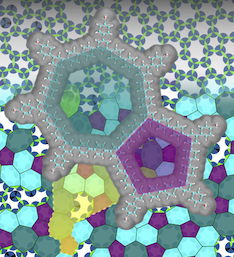
S. Whitelam, I. Tamblyn, T.K. Haxton, M.B. Wieland, N.R. Champness, J.P. Garrahan, and P.H. Beton Physical Review X, 4, 011044 (2014) Building blocks ranging from atoms to micron-scale polymers, differing by orders of magnitude in size and interacting through very different mechanisms, can form network structures that share common topological features. In this work, we show that the self-assembly of this diverse collection of building blocks can be understood within a common physical framework. Using a combination of quantum mechanical calculations, statistical mechanical models, and coarse-grained simulations, we demonstrate that two key parameters -- interaction strength and interaction flexibility -- control the phase behavior and dynamics across all systems studied. Flexible interactions favor nonperiodic polygon networks, while inflexible interactions favor periodic honeycomb structures. Weak bonds allow networks to evolve toward equilibrium honeycomb configurations, while strong bonds lead to kinetically trapped glassy networks. These results show that atomic and chemical details matter less than geometric and energetic parameters, enabling rational design principles for programming self-assembling materials across scales. |