|
A Density Functional Tight Binding Model with an Extended Basis Set and Three-Body Repulsion for Hydrogen under Extreme Thermodynamic Conditions
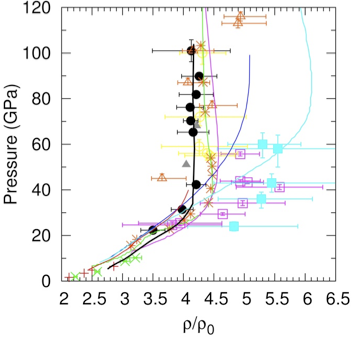
S.G. Srinivasan, N. Goldman, I. Tamblyn, S. Hamel, and M. Gaus Journal of Physical Chemistry A, 118, 5520-5528 (2014) Modeling hydrogen at high pressures and temperatures is essential for understanding planetary interiors and achieving controlled fusion, yet standard computational methods struggle under these extreme conditions. In this work, we develop a new density functional tight binding (DFTB) model that incorporates an extended basis set with polarizable p-orbitals and environmentally dependent three-body repulsive interactions. The use of an extended basis set is necessary under dissociated liquid conditions to account for the substantial p-orbital character of the electronic states around the Fermi energy. This DFTB-p3b model demonstrates significantly improved agreement with both full density functional theory calculations and experimental shock Hugoniot data for hydrogen up to 100 GPa and 25,000 K. Our approach provides a general method to extend the DFTB framework for a wide variety of materials over a significantly larger range of thermodynamic conditions than previously possible, offering a computationally efficient alternative to full DFT simulations at extreme conditions. |