|
Optical lattice experiments at unobserved conditions and scales through generative adversarial deep learning
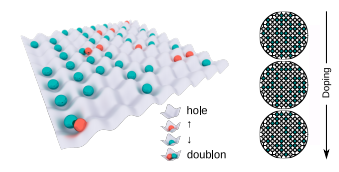
C. Casert, K. Mills, T. Vieijra, J. Ryckebusch, and I. Tamblyn Physical Review Research, 3, 033267 (2021) Devising theoretical models that faithfully describe all experimental observables in ultracold quantum gas experiments remains a major challenge. In this work, we develop a conditional generative adversarial network (GAN) that learns directly from experimental snapshots of a doped two-dimensional Fermi-Hubbard model realized in an optical lattice. The network accepts physical parameters such as doping level and temperature as input and generates synthetic experimental configurations that are statistically indistinguishable from real data across multiple metrics, including spin correlations and string pattern statistics. Remarkably, the trained model can successfully predict system behavior at experimentally inaccessible conditions, including larger system sizes (approximately four times more lattice sites) and untrained parameter ranges. This demonstrates that generative deep learning can effectively model complex experimental quantum systems, enabling exploration of conditions and scales currently beyond experimental reach while maintaining physical fidelity. |