|
Deep learning and high harmonic generation
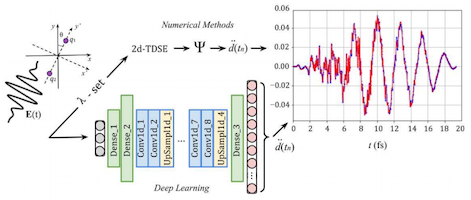
M. Lytova, M. Spanner, I. Tamblyn Canadian Journal of Physics, 101, 3 (2022) High harmonic generation (HHG) -- the process by which intense laser light interacting with atoms and molecules produces radiation at many multiples of the driving laser frequency -- is a powerful tool for ultrafast spectroscopy, but theoretical calculations of HHG spectra are computationally demanding. In this work, we explore the application of deep neural networks to several tasks related to HHG in reduced-dimensional models of small molecules. We train networks for forward prediction of HHG dipole emission and spectra from molecular parameters such as laser pulse intensity, internuclear distance, and molecular orientation, as well as for the inverse problem of determining molecular parameters from observed HHG spectra. We further demonstrate that transfer learning allows pre-trained networks to be adapted with minimal additional training data, and that simpler fully connected networks can successfully classify molecules by type. These results suggest that neural network architectures could serve as rapid and effective spectroscopic tools, with potential for integration into actual HHG experiments when trained on experimental data. |