|
Automatic graph representation algorithm for heterogeneous catalysis
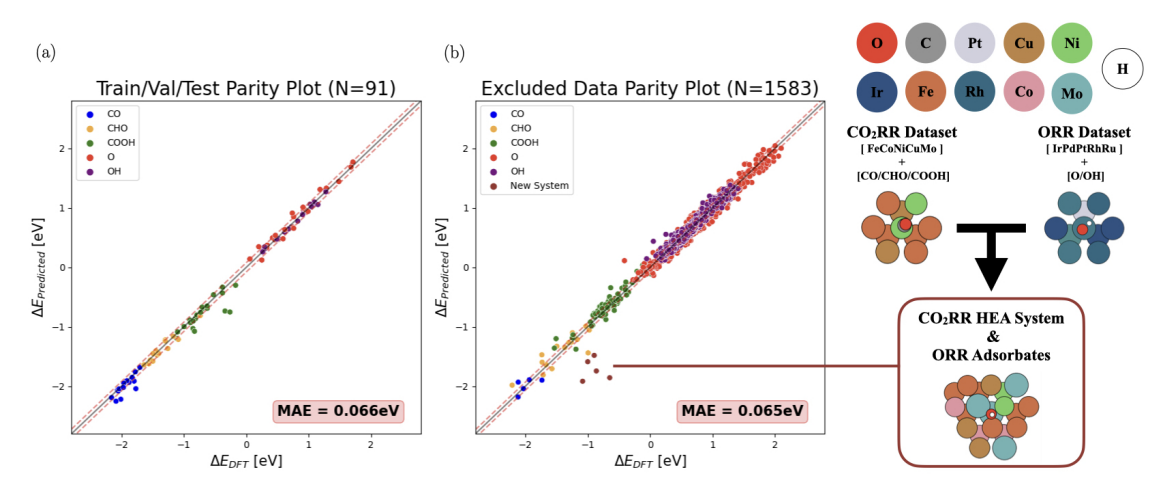
Z. Gariepy, Z. Chen, I. Tamblyn, C. Veer Singh, C.G. Tetsassi Feugmo APL Machine Learning, 1, 3, 036103 (2023) Applying machine learning to accelerate catalyst discovery requires converting atomic structures into suitable numerical representations, a process that typically involves significant manual preprocessing and domain-specific feature engineering. In this work, we introduce AGRA (Automatic Graph Representation Algorithm), a framework that automatically extracts local chemical environments surrounding adsorption sites on metallic surfaces and converts them into graph representations for use with graph neural networks. AGRA identifies atomic connectivity using radius-based neighbor lists, classifies adsorption geometries (on-top, bridge, hollow-fcc, hollow-hcp), and generates graph representations with embedded node and edge descriptors. Tested on oxygen reduction reaction (ORR) and CO2 reduction reaction (CO2RR) datasets using three graph neural network architectures (NNConv, CGCNN, ALIGNN), AGRA achieves root-mean-square deviations as low as 0.048 eV for OH adsorption energies and demonstrates strong transferability to previously unstudied catalyst systems, all while reducing computational costs compared to existing approaches such as the Open Catalyst Project. |