|
Navigating the materials space with machine-learning-generated electronic fingerprints
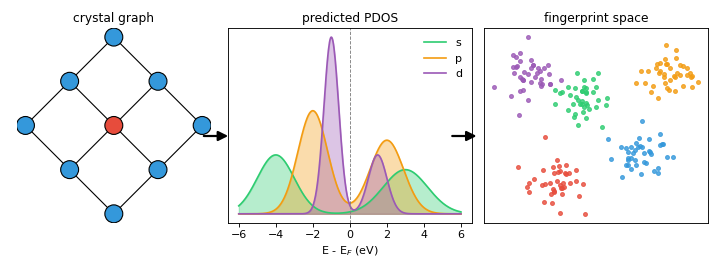
I. Neporozhnii, Z. Wang, R. Bajpai, C. Gomez, N. Chakraborty, T. Dong, I. Tamblyn, S. Hoogland, O. Voznyy PRX Intelligence, 1, 1, 013014 (2026) Finding new materials for technologies like solar cells, catalysts and batteries often comes down to finding compounds with the right electronic structure. Computing that structure from first principles is expensive, which limits how much of materials space can be searched. In this work, we introduce ProDosNet, a graph neural network trained to predict the atom- and orbital-resolved projected density of states (PDOS) of crystalline materials at very low computational cost. We use it to generate electronic fingerprints for every compound in the Materials Project and cluster them by orbital-resolved similarity. These fingerprints reveal materials that look quite different structurally but share similar electronic properties, giving a new way to navigate materials space for photovoltaics, catalysis and battery applications. |